
An opinion piece by Anastasija Rackovska, IRM Financial Services Group, on the increasing number of people opting out of their pension contributions.
A recent BBC story highlighted by LinkedIn News about young people opting out of workplace pensions has sparked an interesting discussion. Are younger generations losing interest in saving for retirement? Before concluding, let’s look at the wider picture.
According to the UK Department for Work and Pensions, 90% of eligible employees in Great Britain were saving into workplace pensions in 2025. That is 22.6 million people. At the same time, the proportion of newly enrolled workers actively opting out has increased to around 11-12%.
Both figures are correct. They simply measure different groups of people.
The increase in opt-outs is worth examining. But individual stories, even compelling ones, are not enough to conclude that an entire generation is turning away from pensions. And there is another interesting figure. In May 2026, the UK Pensions Commission estimated that around 15 million people were not saving enough for retirement. So perhaps the question goes beyond whether young people are choosing to contribute.
What can any of us realistically expect from our pensions in 30 or 40 years?
Two types of pensions, two different risks
To understand the problem, we first need to distinguish between two main sources of retirement income in the UK. The State Pension is paid by the government. Eligibility and the amount received depend largely on a person’s National Insurance record. It is financed from current government revenues. In simple terms, today’s working population helps pay for today’s pensioners. The workplace pension is different. Employers arrange pension schemes for their employees, with contributions generally coming from both the employer and employee.
There are two main types.
With a defined contribution pension, money is invested for the individual. The amount available at retirement depends on contributions, investment performance, and how the money is eventually taken. With a defined benefit pension, future payments are calculated according to the scheme’s rules, often using salary and years of service. These arrangements face different financial risks.
Official explanations: UK State Pension and Types of Private Pensions.
The challenge for State Pensions
According to the Office for National Statistics, the number of people of State Pension age in the UK is projected to increase from 12.4 million in 2024 to 14.2 million by 2034. The working-age population is also expected to grow, but more slowly; this means there will be fewer working-age people relative to the number of pensioners, and there is a fairly simple financial problem here.
If the number of pensioners grows faster than the working population, how will future pension payments be financed?
The UK’s Office for Budget Responsibility projects that State Pension spending could increase from around 5% of GDP to 9% by 2075 – 76 under its baseline assumptions. That is a considerable increase, so does it mean State Pensions will disappear? No. Governments can change retirement ages, taxes, pension benefits and funding arrangements, but it would be reasonable to question whether the pension system we know today will operate under the same rules in another 40 years.
We are living longer. Much longer.
Consider how much has already changed: according to the Office for National Statistics, life expectancy at birth in England and Wales was approximately 40 years for men and 42 years for women in 1841. By 2020, those figures had increased to approximately 79 and 83 years.
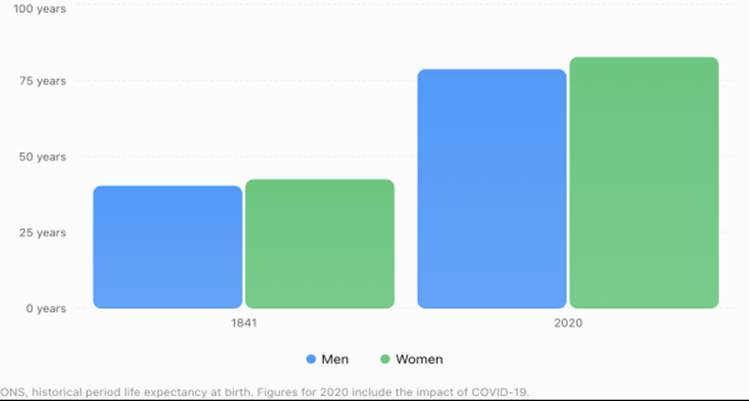
Of course, much of this historical improvement came from reducing infant and childhood mortality. It does not mean that adults in the nineteenth century generally died at 40. Nevertheless, improvements in medicine, living conditions and public health have changed how long people live, and further changes are expected.
The latest ONS projections published in May 2026 estimate that 26.3% of girls and 18.3% of boys born in the UK in 2049 could live to at least 100.
Think about what that means for retirement: someone retiring at 65 may need to finance 30 or even 35 years of life without regular employment income. Not everyone will live that long, of course. But retirement planning must consider that possibility.
And medicine is still advancing
There is another factor that makes long-term predictions difficult: medical research continues to produce results that would have seemed extraordinary not long ago. In 2023, researchers demonstrated a brain-spine interface that allowed a person with paralysis following a spinal cord injury to stand and walk again with technological assistance. It was an early study involving one person, but an impressive result. In the same year, the UK’s Medicines and Healthcare products Regulatory Agency authorised the first CRISPR-based medicine for certain inherited blood disorders.
Treatments that previously seemed impossible are becoming possible.
Does this mean human life expectancy will suddenly increase much faster than current projections suggest?
We do not know. These medical advances do not, by themselves, prove that people will live longer. But they show how quickly treatment possibilities can change. And we cannot know exactly what medicine will be capable of 20 or 30 years from now.
The labour market is changing too
Now add another factor: artificial intelligence. According to the International Labour Organization, one in four workers worldwide has a job with some level of exposure to generative AI. The organisation expects many jobs to change rather than disappear entirely. Some tasks may no longer require the same number of people. New jobs may emerge. Skills that are valuable today may become less relevant. How will this affect employment, salaries, working lives and pension contributions over the coming decades?
There are plenty of predictions. But nobody has a crystal ball. These changes may create new challenges, but they may also bring opportunities. Either way, the labour market of the future will look very different from the one we know today.
What about workplace pensions?
All this makes workplace pensions particularly relevant. They can provide another source of retirement income, reducing dependence on the State Pension alone, but they also carry risks. In defined contribution schemes, investments can lose value. The accumulated amount may be insufficient, and inflation can reduce what those savings will buy.
There are protections against certain types of pension provider or employer failure, but these protections do not eliminate investment risk and we should not forget the immediate financial pressure faced by some younger workers. Someone struggling to pay rent or cover essential expenses today may have very reasonable grounds for considering whether to pause pension contributions. However, doing so can mean losing employer contributions, tax benefits and years of potential investment growth.
Both decisions have consequences. What matters is understanding them before making the choice.
What will our pensions actually buy?
There is another risk worth considering: inflation.
Imagine that €5,000 a month would give you a comfortable retirement today. At an average inflation rate of 3% a year, you would need approximately €9,000 a month in 20 years to afford the same lifestyle. Of course, we do not know what inflation will be over the next 20 years. This is simply an illustration. Some pension payments rise with inflation. Pension investments can also grow over time. But the level of protection depends on the pension arrangements and investment performance. So when planning for retirement, we should probably ask not only how much money we expect to receive, but what that money will actually buy.
Preparing for a future we cannot predict
Now, let’s put everything together.
We have an ageing population, with fewer working-age people relative to pensioners. People are expected to live longer, meaning retirement income may need to last for more years. Medical developments continue to change what is possible, and future discoveries may influence how long and how well we live. AI is already changing the labour market, and we do not know exactly what that will mean for employment and earnings in the coming decades. Add inflation, investment risks and the possibility of changing pension rules. All these factors influence how pensions may work and what people can expect from them. We can make forecasts. We can calculate different scenarios. And we should. But we cannot know exactly how these factors will develop or how governments, businesses and individuals will respond. I would not assume that pensions will disappear. Nor would I suggest that younger people should stop contributing. Quite the opposite. Pensions can be an important part of preparing for retirement, particularly when employer contributions are available.
But personally, I would not plan my entire financial future on the assumption that today’s pension arrangements will remain unchanged.
So perhaps, instead of trying to predict exactly what will happen, we should start by asking ourselves a few practical questions.
1. What kind of life do I want when I retire, and how much would it cost?
Think about the income you would need today. Then consider how much more you might need by the time you retire, allowing for inflation.
2. How much can I realistically expect from my existing pensions and savings?
Understand what you are contributing, what you might receive, and whether those amounts are likely to be enough to support your expected lifestyle.
3. What other options would I have if that income turned out to be insufficient?
Could you rely on other savings, investments or sources of income? What would happen if you needed to retire earlier than planned?
4. If I am not financially prepared, what could I start doing today?
Perhaps you need to increase your savings, learn more about investing or build another source of income.
And perhaps you are not in a position to do any of those things right now. In that case, what would be your first realistic step towards getting there?
I do not think the future will necessarily be worse. It may be better in ways we cannot imagine today, but it will probably be different. And being prepared for change does not mean expecting the worst. It means understanding what we depend on, recognising what could change, and having alternatives where possible.
We cannot prepare for every possible future, but we can give ourselves more options.